8 Lessons I Learned From 8 Years of Podcasting
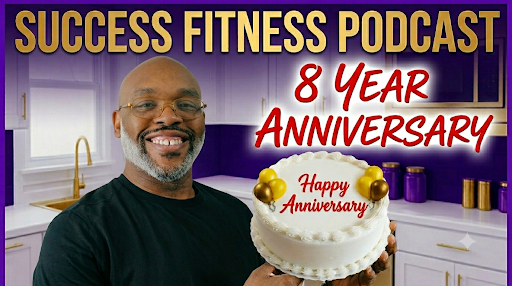
Today is June 17, 2026, and the Success Fitness Podcast celebrates its 8th anniversary.
The number eight has always meant a lot to me. Eight represents new beginnings, and when turned on its side, it becomes the infinity symbol. As a lifelong Lakers fan, I also think of the late great Kobe Bryant and his famous number eight jersey. The number has shown up throughout my life in meaningful ways, including when my second niece was born exactly eight months after my mother passed away.
On June 17, 2018, I published my very first podcast episode. Since then, there have been ups and downs, lefts and rights, zigs and zags. Looking back over these past eight years, I’ve identified eight lessons that podcasting has taught me.
Lesson #8: Consistency Is Key
One of the biggest lessons I’ve learned is the importance of consistency.
When I first started the podcast, I consistently showed up every week. I was always thinking about future topics, future guests, and what value I could provide to listeners. Publishing became part of my routine.
Then life happened.
Over time, I became consistent in not publishing. Outside of this anniversary episode, I haven’t released a new episode in months. I became consistent in my inconsistency.
That realization has carried over into other areas of my life as well. Consistency works both ways. You can become consistent in positive habits just as easily as you can become consistent in avoiding them.
Moving forward, I want consistency to be one of my guiding principles again.
Lesson #7: The Importance of Delegation
Another lesson I’ve learned is the importance of delegation.
For years, I tried to do everything myself. I handled topics, guest outreach, thumbnails, editing, publishing, and promotion. Looking back, I realize I should have reached out for help much sooner.
Whether it was finding guests, editing audio, creating video content, or designing thumbnails, there were opportunities to build a support system that I simply didn’t take advantage of.
This lesson extends far beyond podcasting. Learning to trust other people with responsibilities is a life lesson as much as it is a business lesson.
If I want this podcast to continue growing, delegation can’t be optional.
Lesson #6: Authenticity Matters
Before he passed away, my cousin Sean gave me some advice that has stayed with me.
He told me to talk to my audience the same way I talked to him.
At first, that was difficult because I thought I was already doing that. The more I reflected on his advice, however, the more I realized I was often overthinking things.
I was constantly asking myself:
Who is this for?
Will people like this topic?
Will this resonate with the audience?
Those questions often got in the way of authenticity.
Over the years, this podcast has taught me to be more transparent about what I’m experiencing, what I’m learning, and what I’m thinking. Sometimes authenticity means recording an episode. Other times, authenticity means not recording at all.
I was raised to believe that if you don’t have anything nice to say, don’t say anything at all. There have been times when I had something to say, but it wasn’t something positive. During those moments, staying away from the microphone was the authentic choice.
Authenticity isn’t just about speaking your truth. Sometimes it’s about knowing when silence is the better option.
Lesson #5: Your Podcast Audience Isn’t Always Your Social Media Audience
One lesson that surprised me was realizing that my podcast audience differs from my social media audience.
When I started personal training, most of my clients were women. Naturally, many of my podcast topics reflected the conversations I was having with them regarding health, fitness, and lifestyle concerns.
Over time, however, I noticed something interesting.
My podcast audience closely resembled my Facebook audience, which is primarily women between the ages of 35 and 55.
My YouTube audience, on the other hand, is mostly men between the ages of 25 and 45.
Those are two very different groups of people.
As I entered my forties, I found myself wanting to discuss topics that reflected my own experiences as a man. Questions about aging, health, mindset, and life transitions became more relevant to me personally.
As a result, I’ve gradually shifted my content toward men’s issues because those are the topics I’m currently living through myself.
This doesn’t mean I no longer value my female audience. It simply means that authenticity has pushed me toward speaking more directly about the experiences I’m having today.
Especially during Men’s Mental Health Awareness Month, I feel a responsibility to have more conversations directed toward the fellas.
Lesson #4: Monetization Starts From Within
Early on, I thought podcast monetization meant sponsorships.
I wanted companies to pay for ad space. I wanted deposits hitting my account. I wanted the podcast itself to generate income.
Over time, my perspective changed.
I realized I already had products and services that could benefit from the platform I had built.
Instead of focusing solely on external sponsors, I could promote:
- Personal training services
- E-books
- Merchandise
- My website
- My YouTube channel
The podcast itself became a marketing channel.
Once I understood that, my entire approach to monetization expanded. Rather than waiting for someone else to pay me, I learned how to create value from assets I already owned.
Lesson #3: Interviews Require More Work Than You Think
There was a period when I interviewed a lot of people.
I would reach out to individuals who had experienced significant weight loss transformations and invite them to share their stories on the podcast.
Some responded. Some didn’t.
One lesson I learned quickly was that nobody owes you their story.
Even if someone posts their fitness journey online, that doesn’t mean they’re interested in discussing it publicly on a podcast.
For those who did agree, the logistics were substantial:
- Scheduling
- Time zone coordination
- Technical setup
- Internet connectivity
- Research
- Question preparation
- Video production
Interviews taught me a tremendous amount, but they also required significantly more planning than solo episodes.
While I enjoyed the conversations and the relationships that developed from them, I eventually realized just how much work goes into producing quality interview content.
Lesson #2: Don’t Be Afraid to Evolve
When I launched the Success Fitness Podcast in 2018, it was audio only.
To be honest, I still prefer audio.
I listen to podcasts while driving, walking, working out, and doing everyday tasks. Most of the time, I don’t even look at the screen.
As podcasting evolved, however, video became increasingly important.
I experimented with cameras, recording setups, microphones, and YouTube uploads. I spent countless hours trying to make everything work properly.
Some of it worked.
Some of it didn’t.
What I learned is that evolution doesn’t necessarily mean doing what everyone else is doing. Evolution means adapting in a way that makes sense for your goals and resources.
Today, I’m recording this episode on my phone with a microphone connected directly to it.
It’s not a professional studio setup.
But you can hear me.
And that’s what matters.
Lesson #1: Just Start
The most important lesson I’ve learned over these past eight years is simple:
Just start.
When I launched the podcast, it was simply an extension of my blog, ChristianWeightSuccess.net. It gave me a place to express my thoughts and discuss topics that mattered to me.
Over the years, I’ve talked myself out of recording countless episodes.
Sometimes I felt like my ideas weren’t good enough.
Sometimes I felt like reading a news article and discussing it was too easy.
Sometimes I wondered whether anyone even cared.
Yet every time I stopped, I eventually came back.
And every time I came back, I realized the same thing:
The hardest part is getting started.
If you’ve been thinking about starting a podcast, start.
Pick a topic.
Turn on a microphone.
Speak.
If you change topics next week, that’s okay.
If you improve over time, that’s expected.
But none of it happens until you begin.
I’ve noticed that when I stop recording for long periods of time, I feel bottled up. I feel restrained. Podcasting gives me an outlet to express ideas, thoughts, and experiences that might otherwise stay trapped inside.
The past couple of years have been difficult. I’ve experienced losses within my family that have impacted me deeply. During those times, I didn’t always feel like recording.
But when I saw the reminder on my calendar for the podcast’s anniversary, I knew I needed to acknowledge this milestone.
Not recording would have been another form of procrastination.
So here we are.
Thank You For Eight Years
These are the eight lessons I’ve learned from eight years of publishing the Success Fitness Podcast:
- Consistency is key.
- Learn to delegate.
- Be authentic.
- Understand your audience.
- Monetize strategically.
- Interviews require extra effort.
- Don’t be afraid to evolve.
- Just start.
To everyone who has listened over the years, thank you.
Thank you for sticking with me through the ups and downs. Thank you for your patience during periods of inconsistency. Thank you for taking something positive away from these conversations.
Whether you’ve been listening for eight years or this is your very first episode, I appreciate you.
Take care of yourself.
Pray for peace.
Pray for love.
Strengthen your relationship with God.
For me personally, that means my Lord and Savior, Jesus Christ.
I’ve found that when I begin my day with prayer and keep God at the center of my life, my days are better than when I don’t.
If there’s one thing I hope you take away from this podcast, it’s that.
Success Fitness has always meant more than physical fitness.
If we’re alive, we have an opportunity to succeed.
To succeed in life, we must be fit mentally, physically, spiritually, and financially. Fitness means becoming stronger in the areas where life challenges us.
Life gets heavy.
The only way to get stronger is to lift more weight.
Peace out.